BORDERLESS LIQUIDITY
The Architecture of Artificial Boundaries
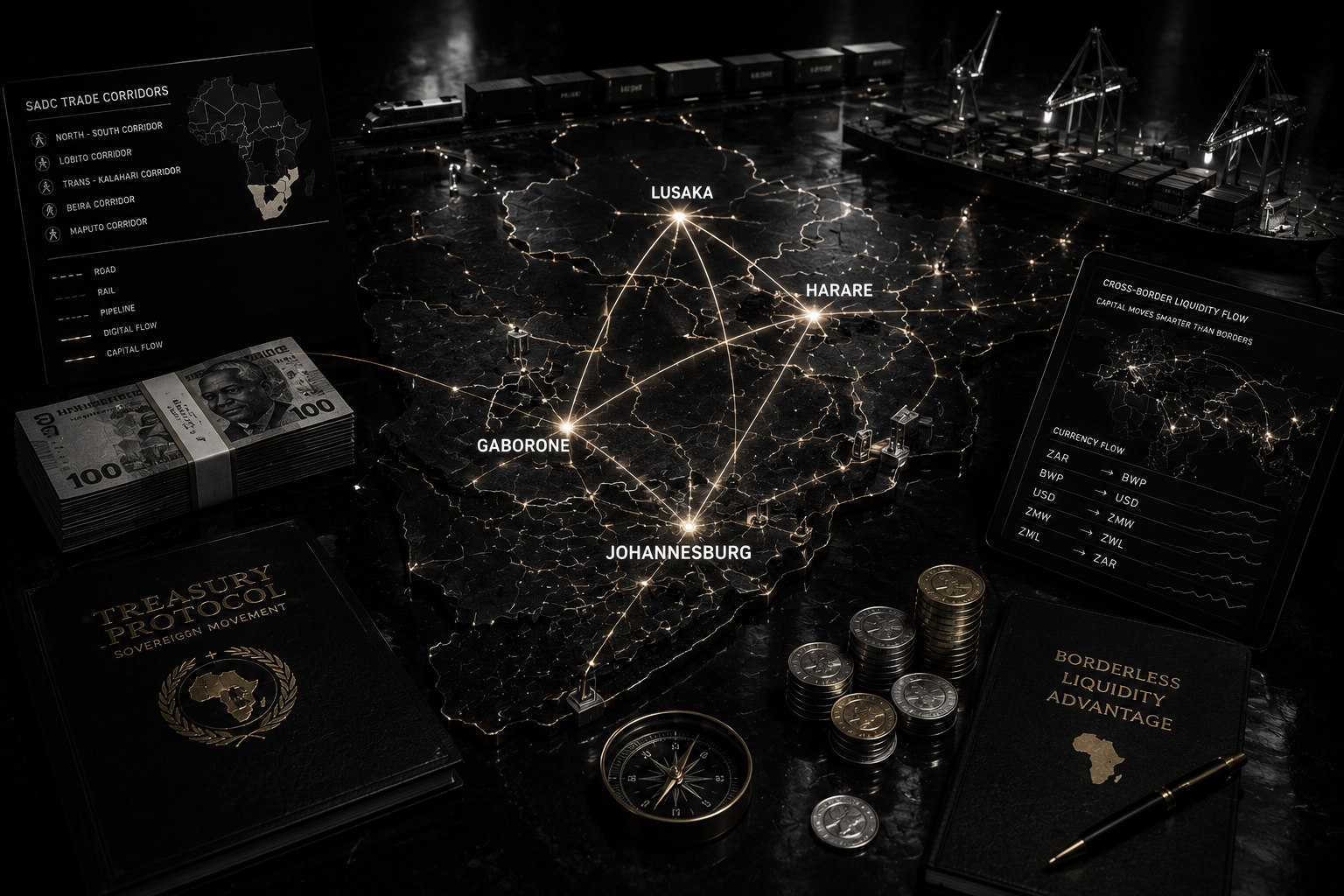
The map of Southern Africa is a political illusion. The lines drawn between South Africa, Botswana, Zimbabwe, and Zambia were designed by historical architects to contain the masses, control the movement of cheap labor, and tax the compliant. For the average citizen, a border is a formidable wall—a place of harassment, paperwork, and financial restriction. For the modern African strategist, however, a border is not a barrier; it is a porous membrane. It is a calculated friction point where the value of money fundamentally alters, creating a massive opportunity for those who understand how to exploit the spread. The Badman does not operate within the confines of a single national economy. He understands that patriotism has absolutely no place in a treasury. If you restrict your commercial vision to the country of your birth, you are subjecting your entire empire to the whims of a single, often incompetent, central bank. The Warlord demands borderless liquidity. He views the entire region as a single, fluid chessboard, and he moves his capital across it with lethal precision to extract maximum leverage.
The Currency Casino and the Fiat Trap
To master borderless liquidity, you must first recognize the trap of single-currency reliance. The masses earn, save, and spend in the exact same fiat currency, rendering them completely defenseless against regional inflation and political mismanagement. When you are chained to a single currency, you are effectively sitting at a casino where the government controls the odds, the dealers, and the exits. Consider the operational theater of the Southern African region. The South African Rand is a highly volatile instrument, subject to the violent swings of global market sentiment and domestic political gridlock. The Botswana Pula stands as a beacon of managed stability, anchored by diamond reserves and disciplined fiscal policy. Meanwhile, the Zimbabwean economy operates as a rugged, multi-currency frontier where the US Dollar is the supreme, undeniable king of the shadow economy. The amateur operator sees this fragmented landscape as a logistical nightmare. The Bandit sees it as a structural arbitrage opportunity. If you are operating a business in only one of these environments, you are absorbing all the risk and capturing none of the leverage.
The Arbitrage Protocol
Arbitrage, in its purest form, is the simultaneous purchase and sale of an asset in different markets to exploit pricing inefficiencies. In the context of the Badman’s empire, it means restructuring your corporate DNA to earn in strong currency while settling operational costs in weak currency. It is the deliberate weaponization of foreign exchange. The execution of this protocol is highly methodical. The strategist establishes revenue-generating mechanisms in stable, high-value jurisdictions. He secures clients and contracts that pay exclusively in US Dollars, Euros, or Pula. However, he refuses to house his operational overhead in those same expensive markets. Instead, he shifts his labor costs, his digital infrastructure maintenance, and his raw material sourcing across the border into territories where the local currency is actively depreciating against his treasury. When you pay a supplier in Rand using a Pula-backed war chest, you are not just making a purchase; you are actively giving yourself an invisible, compounding discount on every single transaction. You are forcing the macroeconomic incompetence of the region to subsidize your profit margins.
The Sovereign Treasury and the Tripod Deployment
True borderless liquidity cannot be achieved by carrying stacks of physical cash across borders in the dead of night. That is the behavior of a smuggler, not a sovereign operator. The Badman builds legal, invisible, and impenetrable corporate infrastructure. He establishes a tripod of deployment across the region, structuring his entities to pass capital seamlessly through the bureaucratic friction. A dominant operator builds his corporate sanctuary strategically. He places his central treasury and intellectual property in Gaborone, where the banking sector is stable and capital controls are rational. He places his aggressive, client-facing sales engines in Midrand or Sandton, tapping into the massive, high-velocity consumer market of South Africa to generate volume. Finally, he maintains a tactical presence in Chinhoyi or Harare, recognizing that highly distressed markets offer unprecedented opportunities to acquire heavily discounted physical assets using the hard currency generated by the rest of the empire. Capital flows seamlessly between these nodes, legally bypassing the traps set for the average citizen. By incorporating across multiple jurisdictions, the Warlord ensures that no single government can freeze his momentum, audit his entire existence, or dictate his financial destiny.
The Strategist’s Decree
Look at your current banking architecture. If your entire net worth, your operational cash flow, and your corporate registration sit within the borders of a single nation, you are operating in a state of extreme vulnerability. You are one policy shift, one hyperinflationary spiral, or one banking crisis away from total ruin. The commercial battlefield is borderless, and your treasury must reflect that reality. Stop playing the local game. Establish the tripod. Weaponize the currency spread. Secure your capital in stable zones, deploy your operations in volatile zones, and extract the difference. The market belongs to the operator who is everywhere at once, yet anchored nowhere.
Reclaim your throne, silence the noise of the collective, and let the market know the general has finally taken the pass.